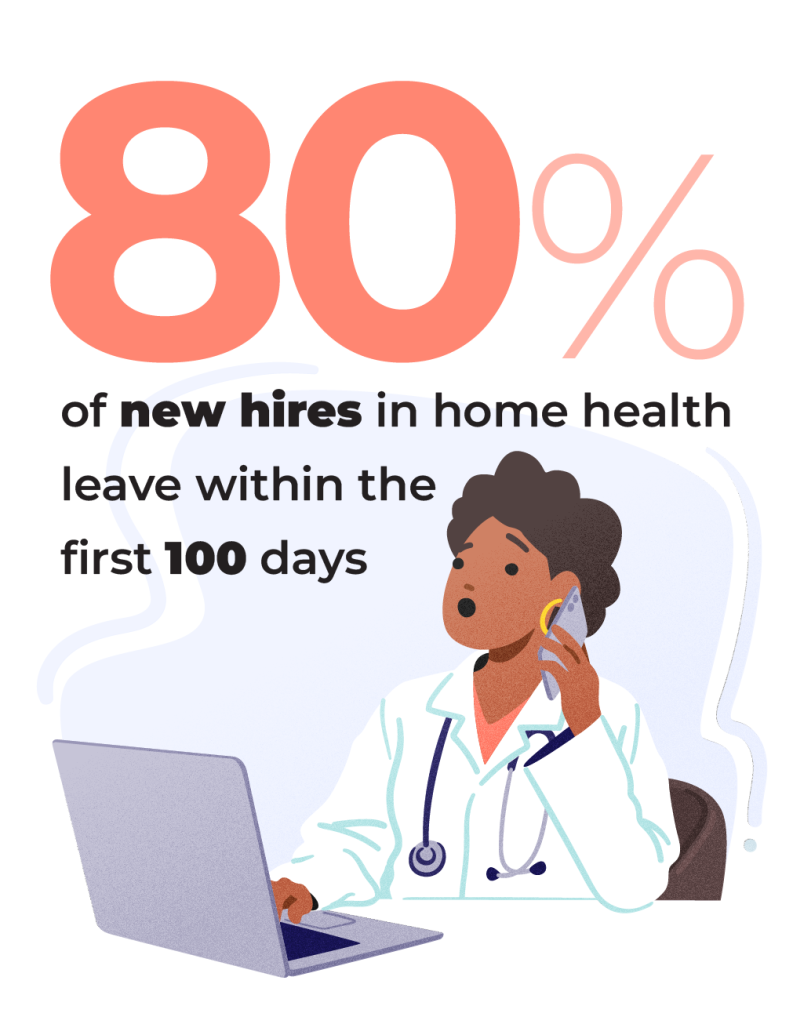








It’s no secret that the home healthcare industry is still experiencing significant staffing challenges. High turnover rates have been an ongoing issue, reaching nearly 80%—an increase of 12% over two years. This means that approximately four out of every five new hires leave home health agencies within the first 100 days.
This kind of turnover disrupts your day-to-day and your ability to care for patients, but it also strains your finances. New approaches and innovative thinking may be necessary to stay flexible and maintain financial security.
Why you should improve staff retention in healthcare
There are two critical reasons to improve staff retention, and both directly impact your business and operations. The first is to enhance patient care and outcomes. The second is to reduce costs and create financial stability.
Better patient outcomes
High staff turnover and low retention leave positions unfilled, forcing existing staff to handle more work and patients. Studies show that when nurses are overworked, patient outcomes suffer.
With less experienced staff and shorter patient visits due to limited nurses meeting increased demand, care gaps can arise, and complications may go unnoticed. This can lead to more hospital readmissions and impact care quality.
Building a steady, loyal workforce with experience while providing ongoing supervision and training makes a difference. The result being that nurses have the time they need with patients and can deliver appropriate care.
Better financial resilience
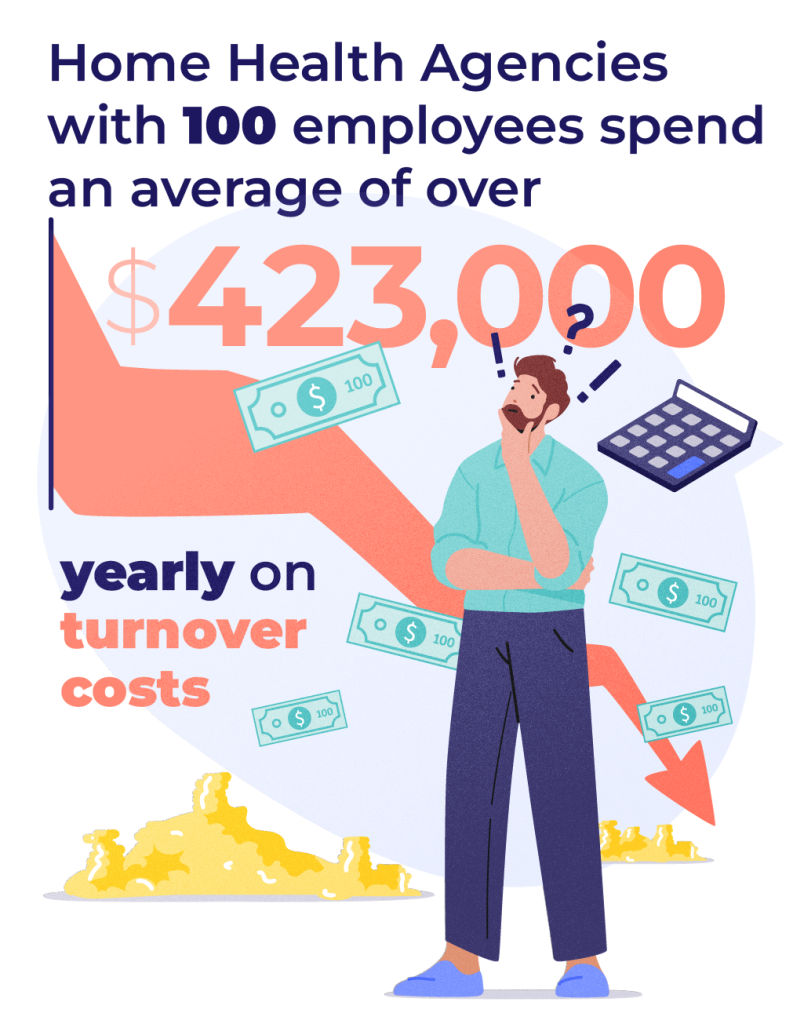
According to reports, home health agencies with 100 employees spend an average of over $423,000 yearly on turnover costs. These kinds of expenses seriously cut into your earnings and challenge your ability to operate and stay afloat.
Focusing on staff retention helps lower these costs. Unfortunately, margins are already thin, and reimbursements aren’t rising despite high industry costs. So, keeping your staff longer and spending less on constant recruitment, hiring, and training can help you create savings and better cash reserves.
Challenges for home health agencies
Constantly hiring and training new staff, only to start over again, can be frustrating. Even with efforts to improve retention, challenges like wage demands, heavy workloads, and burnout can make it difficult to keep staff.
Demand for higher wages
Home health agencies have offered lower than average wages in the past, with some states previously paying as little as $8.76 per hour. New laws now set wage standards and staff continue to push for higher pay.
In addition, demand for home health workers is soaring. As demand increases, it becomes an employee’s market, giving them the agency to negotiate higher salaries.
New federal workforce initiatives may help with staffing shortages, but CMS has cut home health rates for 2025 for the third year in a row. Lower payments and rising wage demands create a challenge.
Managing safe workloads
Home health care is demanding work, but staff find it rewarding. Recent surveys of home health workers show that staff are drawn to helping patients. However, they say the work is physically and mentally demanding and interferes with their ability to balance their responsibilities.
The struggle with high turnover makes it difficult for agencies to divide work among existing staff. These two issues together create a cycle that’s hard to find your way out of.
3 ways to improve staff retention in healthcare
The first 90 days of employment are a challenge for most industries. Retaining staff beyond the first three months is often the first goal for many agencies. Fortunately, there are a few things that healthcare organizations can do that can help.
Offset hiring costs with WOTC
The Work Opportunity Tax Credit (WOTC) is a federal and state credit valued between $2,400 and $9,600 for certain new hires. Your new staff must be certified as belonging to a targeted group that faces continuous barriers to employment.
You can work with employment centers to find qualifying staff. However, once hired, you must track wages to identify when your new hire passes the qualifying work period or wages limit and becomes eligible.
The credit helps you hire qualified staff, support job seekers facing barriers, and reduce hiring costs. A payroll platform with WOTC.com and applicant tracking software integrations streamlines the process with easier hiring and onboarding, tracking, simplified forms, and credit processing.
Share labor demands across workforce
Balanced workloads are crucial for staff resilience and job satisfaction. Sharing the work can be done through caregiver float pools, casual labor, and flexible scheduling.
Aim to build up your call-out reserves, so you can easily fill shifts, and try to meet alternative scheduling requests where possible. With more control over their schedules, staff and caregivers can better balance duties and ease work burdens.
Automated scheduling tools can help you simplify dynamic schedules, auto-approve time-off requests, and push open shifts to interested staff. Add incentives with shift premiums or other bonuses for quick and seamless management.
Offer earned wage access
Finally, consider financial perks that help ease stress for your employees like earned wage access (EWA). These tools allow employees to have earned wages deposited into their account when they need it and without needing to wait for pay day.
With EWA, your workforce gains pay flexibility while your payroll teams no longer have to field requests for pay advances. The best EWA tools connect directly to your payroll system for automatic calculations, instant transfers, and real-time updates.
Powering a stable workforce with Empeon
The healthcare industry experiences frequent changes and challenges, but organizations can build a stable and adaptable workforce while maintaining financial stability. Enhancing HR systems can help manage hiring costs and labor demands.
All-in-one payroll solutions like Empeon give you in-depth insights into labor costs and turnover and help you manage your finances. Plus, Empeon partners work directly with payroll, so you and your staff can access the funds you need. Get in touch to learn more.