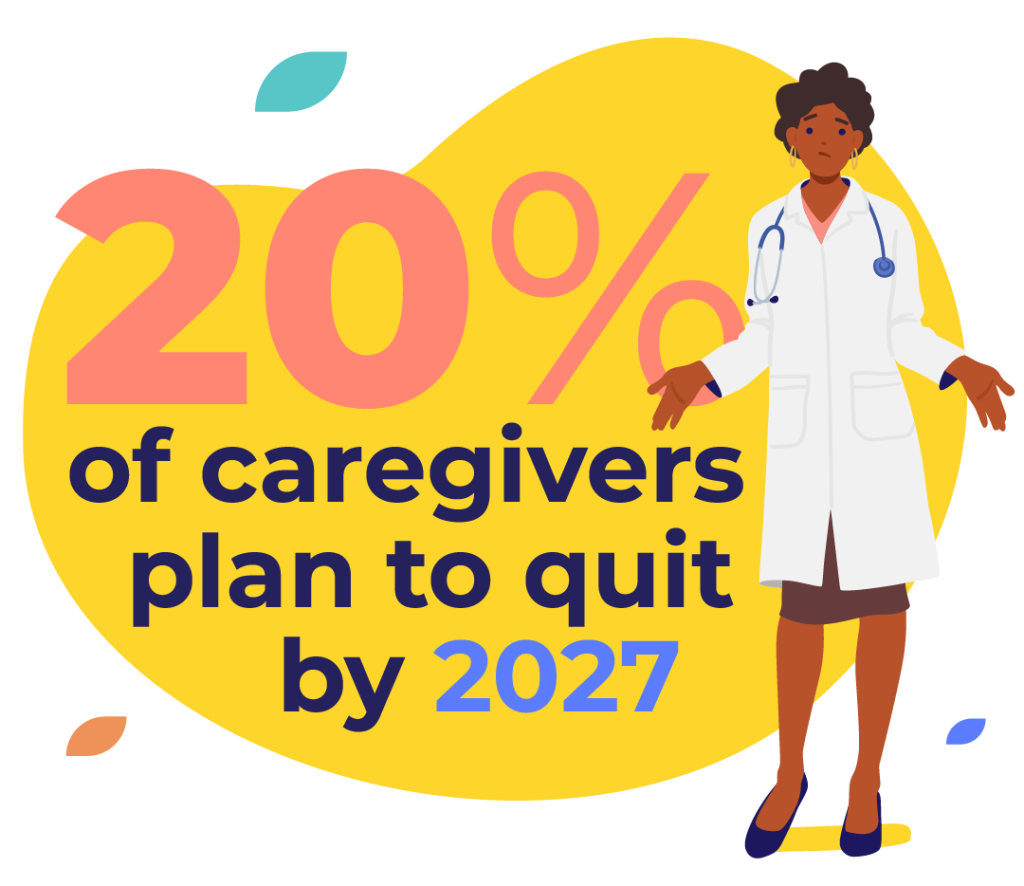
A study found that 610,338 RNs intend to leave healthcare by 2027, and 200,000 young RNs less than 40 also intend to exit. All in all, 1 in 5 plan to quit. Those numbers only put pressure on an already buckling workforce.
Several studies have looked at why caregivers quit, and there are many reasons. Here’s what we know.
Current state of the caregiver workforce
The nursing shortage has been the front page of healthcare news for what seems like ages. For most healthcare fields, staffing levels mostly returned to normal or baseline during the pandemic by the end of 2020, yet exit rates remained above the 2018 baseline levels through the end of 2021. The ongoing news of shortages has prompted some skepticism about the shape of nursing in the US.
However, the skilled nursing and long-term care sectors are the exception to the trend. According to reports, nursing homes lost 15% of their workforce during the pandemic, more than any other sector, and have not recovered. Even after increasing salaries, offering bonuses, and prioritizing promotion, staffing remains challenging.
Recent surveys highlight a few alarming statistics:
- 72% of nursing homes report staffing levels worse than before the pandemic
- 99% of nursing homes report open positions
- 20% have closed a unit or wing because of staffing shortages
- 46% have limited or paused new admission

Unfortunately, those who are leaving the industry are also disproportionately marginalized groups. Conditions and numbers aren’t expected to improve or return to pre-pandemic levels until at least 2026.

Why caregivers quit
So, what is going on? Why do caregivers quit, and why is it mostly affecting the nursing home, SNF, and long-term care sector? There are many reasons, several of which pre-date the 2020 global health crisis and persist despite many efforts and strategies.
Nursing workloads are high. Without enough coworkers to share the burden and fill enough shifts, it just keeps getting worse. Staff have trouble taking time off, finding work-life balance, and meeting family or personal responsibilities.
On top of that, the job itself is stressful. The nursing and caregiving roles come with extreme responsibility, high expectations, long work hours, and chronic exposure to traumatic events.
Additionally, workplace violence and hostility are on the rise, making basic duties even more difficult. To paint a clear picture: 1 in 4 nurses are assaulted at work and 13% of missed days are because of work violence. However, only 20% to 60% of incidents get reported.
Unrelenting stress and poor conditions eventually lead to burnout and exhaustion, which may be physical and emotional. A recent survey found that this is still a pressing issue: 58% of RNs in the US report feeling burned out almost every day.
The overall organizational and management culture is another major concern affecting why caregivers quit. In other words, how human resources and leadership teams interact with nurses and caregivers.
In particular, a lack of support is a persistent issue, and nurses often report they do not feel heard or seen. Given the nature of the workplace, caregivers lack autonomy and have no control over their schedules, yet they desire flexibility. However, they often don’t get it and may not receive recognition or support from managers.
These feelings may lead to frustration, a lack of purpose or meaning and work, and a desire to quit and move on. Sometimes, caregivers find new positions in a different facility. Other times they leave the industry entirely.
Now, pair these high demands with low or few job resources, and nurses can’t catch much of a break. Low or no resources may look like poor support, high workload, toxic culture, lack of connection, and too much admin work that overwhelms the deeper work of caregiving.
Unsafe workplaces, peer bullying, racism and discrimination, whether experienced or witnessed, without resources in place to manage them are harmful to caregiver well-being. These situations and conditions and a lack of support, accountability, and policy all contribute to ongoing issues in the field and why caregivers quit.
Finding better retention solutions
How do you change the current status quo and develop a healthy, engaged workplace? How do you change or strengthen the culture for better staff well-being and retention?
Well, the National Academy of Medicine completed a study looking into these exact concerns. The study generated recommendations based on six key domains, four of which include policy, work environment efficiency, leadership, and support.
In short, these recommendations suggest you:
- Share accountability
- Distribute leadership to those closest to workers
- Encourage and empower instead of command and control
- Maximize tools for efficient workflows
- Support staff—let them do their jobs and give them better workflows and the tools they need
Digital onboarding to overcome why caregivers quit
Based on these recommendations, workplace and workflow efficiency is vital to your retention efforts. Staff need the tools to understand the culture, learn policies, feel empowered, and do their jobs.
The first step is getting this right at the very beginning, right from hiring and onboarding. Digital onboarding solutions can help you share these critical details before staff start their first day.
Starts new hires off on the right foot
The first few days of a new job are often overwhelming, with dozens of forms to read, fill out, and sign, plus documents to review. Each workplace has its way of doing things, which takes time to learn.
However, there’s nothing worse than throwing a nurse into the deep end on their first day and expecting them to perform. Digital onboarding solutions simplify the introductory phase and set your new hires up for success with a gentle and step-wise process.
Introduces caregivers to the company culture
Instant onboarding also helps you explain company values and practices in an easy-to-digest format. Of course, you can have your new staff read and sign off on policies and procedures for due diligence.
However, solutions allow you to embed videos and interactive components to make the experience more engaging. Naturally, these things can be a bit dry and repetitive, so aim to create short, fun, and meaningful videos that help your staff feel leadership and company personality.
Sets alerts and reminders about signatures and pending documents
Then, there are the many other practical tasks onboarding solutions manage. For instance, you can set up automatic alerts about new documents for review, signatures required, or licenses to upload. Staff can quickly check these boxes and submit key forms through a mobile self-service dashboard.
The onboarding workflow automatically goes to the new hire once you enter an email and set it to launch. Staff click on the invitation, set up their self-service profile, and complete the steps. Each completed task automatically triggers the next in line until the entire process is finished.
However, if staff get side-tracked or delay their process, the system automatically sends reminders for missing signatures and pending documents. These auto-reminders reinforce shared accountability and efficiency and empower staff from the beginning.
Captures data correctly the first time
In terms of efficiency, these solutions ramp up accuracy and productivity for your HR teams, lowering the cost of onboarding new hires. Data flows seamlessly from your instant onboarding tools into your payroll modules and record-keeping solution.
You eliminate data entry mistakes that can skew your PBJ reports and cause all manner of compliance nightmares. Once again, you reinforce values that will help improve your work culture and create a better experience for each team member, from caregivers to HR personnel and leaders.
Connect your staff with Empeon as your partner
Empeon’s HCM solutions are a complete answer to all things healthcare HR. In particular, digital onboarding pathways fast-track and simplify orientation, helping you prepare new hires for their first day. Data automatically flows into payroll, creating fewer mistakes and making HR a breeze. Explore our tools and learn how Empeon can power retention.